

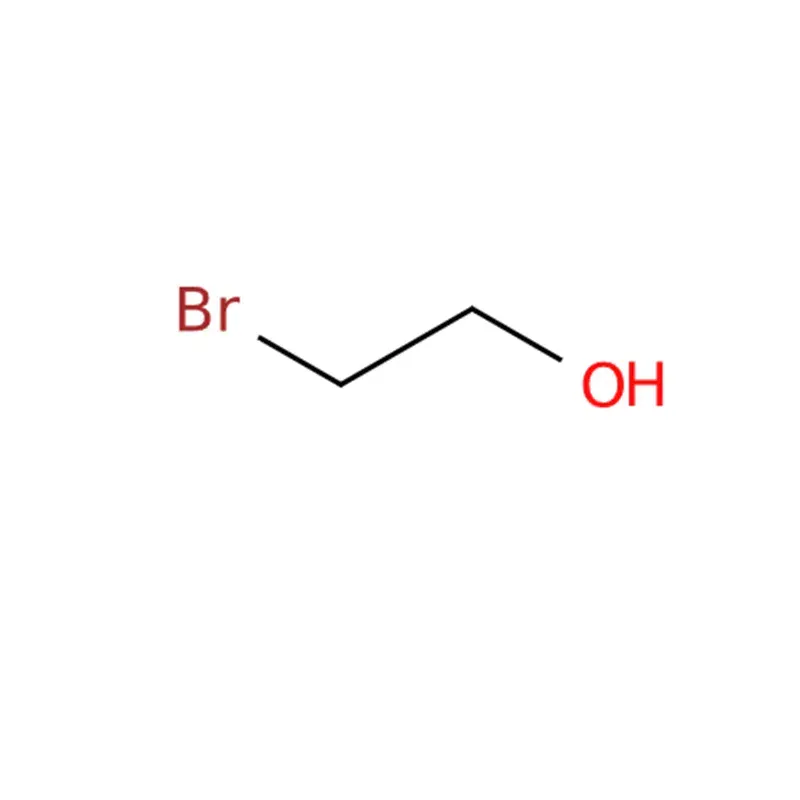
Products Description of 2-Bromoethanol CAS#540-51-2
2-Bromoethanol is a hygroscopic, colorless to pale yellow liquid. Its boiling point is 149–150°C, or 55–59°C at 2.93 kPa. It forms an azeotrope with water at 99.1°C (101.35 kPa). The relative density is 1.7629 (20/4°C) and refractive index is 1.49361. It has a sweet, pungent taste in aqueous solution. It is fully miscible with water and soluble in most organic solvents, excluding petroleum ether. Hydrolysis speeds up under acid, alkali or heating conditions. It is widely adopted for industrial processes and chemical synthesis.

2-Bromoethanol Chemical Properties
| Melting point | -80 °C |
| Boiling point | 56-57 °C/20 mmHg (lit.) |
| density | 1.763 g/mL at 25 °C (lit.) |
| vapor density | 4.3 (vs air) |
| vapor pressure | 2.4 mm Hg ( 20 °C) |
| refractive index | n20/D 1.492(lit.) |
| Fp | >230 °F |
| storage temp. | 2-8°C |
| solubility | 1-5 g/100 mL at 19°C |
| form | Liquid |
| pka | 13.82±0.10(Predicted) |
| color | Clear colorless to yellow |
| Specific Gravity | 1.7629 (20/4℃) |
| Water Solubility | 1-5 g/100 mL at 19 ºC |
| Sensitive | Light Sensitive |
| Merck | 143792 |
| BRN | 878140 |
| Stability: | Stable, but probably light sensitive. Hygroscopic. Incompatible with strong oxidizing agents. Flammable. Forms an azeotrope with water. |
| InChIKey | LDLCZOVUSADOIV-UHFFFAOYSA-N |
| CAS DataBase Reference | 540-51-2(CAS DataBase Reference) |
| NIST Chemistry Reference | Ethanol, 2-bromo-(540-51-2) |
| EPA Substance Registry System | 2-Bromoethanol (540-51-2) |
| Hazard Codes | T,T+,Xn,F |
| Risk Statements | 23/24/25-34-40-36/37/38-26/27/28-10-67-65-48/20-38-11-63 |
| Safety Statements | 26-36/37/39-45-28A-16-62-36/37 |
| RIDADR | UN 2922 8/PG 2 |
| WGK Germany | 3 |
| RTECS | KJ8225000 |
| TSCA | Yes |
| HazardClass | 6.1 |
| PackingGroup | II |
| HS Code | 29055900 |
Key Applications
Organic Synthesis: Acts as a flexible bifunctional intermediate bearing both bromine and hydroxyl groups. It is extensively used for introducing hydroxyethyl groups into target molecules and supporting nucleophilic substitution reactions.


