

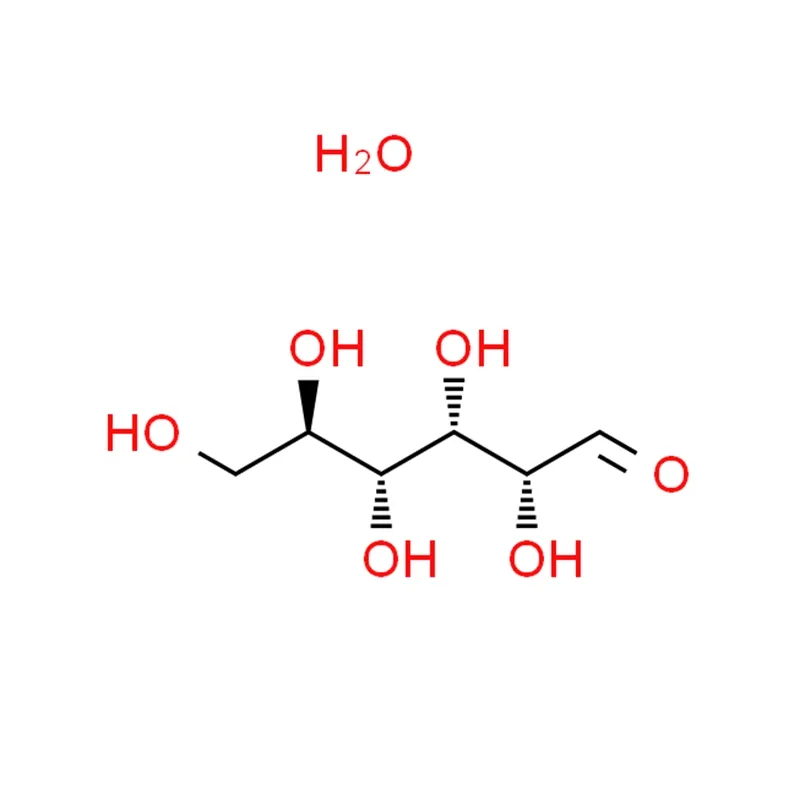
Product Details
E-(+)-Glucose monohydrate, commonly known as glucose or dextrose, features extensive applications in microbiology. It acts as a carbon source in microbial culture media to facilitate the growth and proliferation of various microorganisms. As a simple sugar, it serves as the primary energy source for bacterial metabolism. This naturally occurring sugar participates in energy production, glycosylation, and glycan synthesis to maintain cellular structures. Additionally, it is involved in glycation, an adverse cellular reaction process.

D-Glucose monohydrate Chemical Properties
| Melting point | 83°C |
| Density | 1.54 |
| Solubility | Freely soluble in water, sparingly soluble in ethanol (96 per cent). |
| Form | Solid |
| Color | Colorless crystals |
| Odor | Odorless |
| PH Range | 5.9 |
| Water Solubility | 1 g/1.1 ml water @ 250C |
| InChI | InChI=1/C6H12O6.H2O/c7-1-2-3(8)4(9)5(10)6(11)12-2;/h2-11H,1H2;1H2/t2-,3-,4+,5-,6+;/s3 |
| InChIKey | OSNSWKAZFASRNG-YDLLFKKHNA-N |
| SMILES | [C@H]1(CO)O[C@@H]([C@H](O)[C@@H](O)[C@@H]1O)O.O |&1:0,4,5,7,9,r| |
| CAS DataBase Reference | 5996-10-1(CAS DataBase Reference) |
It can be applied as a sweetener and widely used in food, beverage, confectionery and related industries. In the medical field, it serves as a raw material for glucose injections and sodium glucose oxidate injections, as well as a primary or auxiliary ingredient for oral pharmaceuticals. Additionally, it is adopted in the vegetable preservation industry.