
Product Description of Sodium Amide CAS#7782‑92‑5
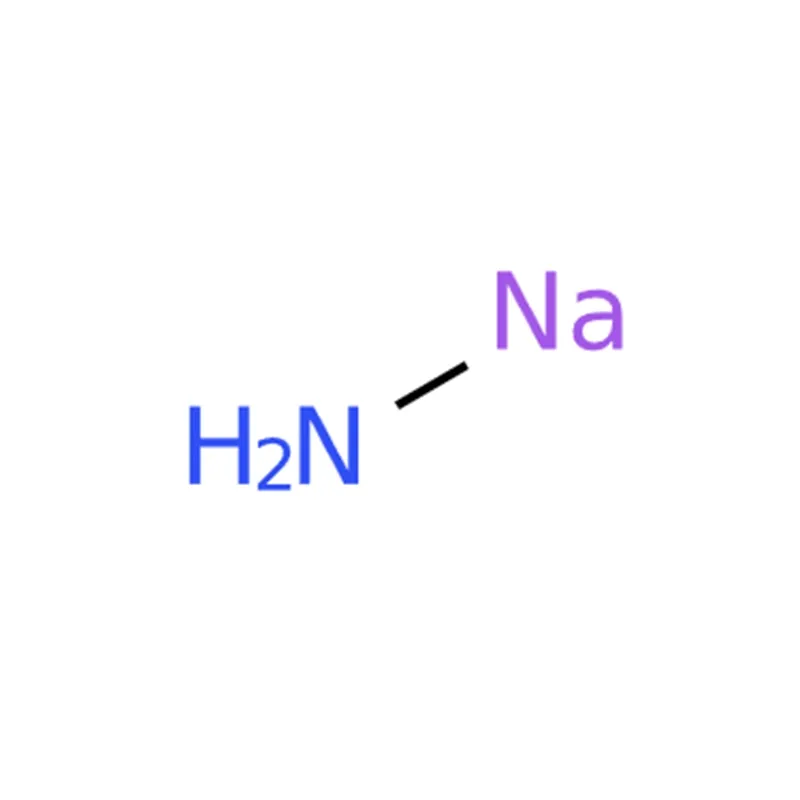
Sodium amide, alternatively called sodamide, appears as white‑to‑olive‑green crystalline solid and carries an ammonia‑type odor. It bears the chemical formula NaNH₂ with a molecular weight of 39.01, a melting point of 210°C and a boiling point of 400°C. Upon being heated to 500‑600°C, the substance decomposes into sodium, nitrogen and hydrogen. It reacts violently with water to generate sodium hydroxide alongside ammonia gas release. It exhibits slight solubility in liquid ammonia and proceeds with slow chemical interaction with alcohols.
Sodium amide readily takes in carbon dioxide and moisture from ambient air, hence sealed packaging is mandatory for storage. Its liquid form is capable of dissolving metallic substances including magnesium, zinc, molybdenum and tungsten; it also corrodes quartz, glass and silicate‑based materials. As an ionic compound built up of amide ions NH₂⁻, it comes into being when hydrogen atoms are stripped off ammonia molecules and the resulting amide groups combine with sodium cations.
This chemical substance is flammable, explosive, corrosive and hygroscopic. Owing to the lone‑pair electrons on amino groups, it tends to capture protons and undergoes intense hydrolysis in water to yield alkaline solutions following the reaction: NaNH₂ + H₂O → NaOH + NH₃. It dissolves in liquid ammonia and hot organic solvents. Its fine dust is toxic and may trigger heavy irritation towards skin, eyes and respiratory tracts; direct physical exposure will give rise to corrosive burns.
Within organic synthesis workflows, sodium amide is extensively adopted as an aminating reagent, condensation promoter, dehydrating agent, dehalogenating substance, alkylating agent and polymerization initiator. Moreover, it acts as a vital feedstock to manufacture hydrazine, sodium cyanide, azides, other cyanide compounds and indigo.
Upon air exposure, sodium amide is prone to oxidation and develops a yellow oxidized surface coating. Certain oxidation derivatives are explosive and may detonate under friction or thermal stimulation. When heated under vacuum between 300‑330°C, sodium amide breaks down into nitrogen, sodium, hydrogen and ammonia. For that reason, it needs to be preserved in hermetic containers filled with inert gas, isolated from air, moisture and all ignition sources.
From an industrial perspective, sodium amide is manufactured through the reaction between molten sodium and ammonia gas at 300‑400°C. For lab‑scale preparation, it can be synthesized by reacting sodium metal with liquid ammonia with catalyst assistance under room‑temperature conditions. In addition, it can react with carbon monoxide to produce sodium cyanide, making itself a significant chemical intermediate.
Sodium amide Chemical Properties
| Melting point | 210 °C (lit.) |
| Boiling point | 400 °C (lit.) |
| density | 1.39 g/cm3 (25℃) |
| Fp | 85 °F |
| storage temp. | Store below +30°C. |
| solubility | reacts with H2O |
| form | crystalline |
| color | Greyish white powder |
| Odor | Ammonia like |
| Water Solubility | REACTS VERY VIOLENTLY, EVEN EXPLOSIVELY |
| Sensitive | Air & Moisture Sensitive |
| Merck | 148576 |
| Stability: | Stability Flammable. Reacts violently with water producing very toxic fumes. In case of fire do not use water, but instead smother with soda ash. May form explosive peroxides if heated, or if stored for extended periods in contact with air or oxygen. Incompatible with water and aqueous solutions, carbon dioxide, halogenated hydrocarbo |
| CAS DataBase Reference | 7782-92-5(CAS DataBase Reference) |
| EPA Substance Registry System | Sodium amide (Na(NH2)) (7782-92-5) |
| Hazard Codes | F,C,Xi,N |
| Risk Statements | 14/15-19-34-20/21-10-67-65-63-48/20-11-36/37-15/29-14-50-29 |
| Safety Statements | 26-43-45-62-7/8-43D-36/37/39-27-16-61 |
| RIDADR | UN 3129 4.3/PG 2 |
| WGK Germany | 2 |
| F | 37917 |
| Autoignition Temperature | 450 °C |
| TSCA | Yes |
| HS Code | 2853 90 90 |
| HazardClass | 4.3 |
| PackingGroup | II |
| Hazardous Substances Data | 7782-92-5(Hazardous Substances Data) |
Product Application of Sodium Amide CAS#7782‑92‑5
It works as a condensation‑promoting reagent within organic chemical reactions and represents an essential starting material for vitamin‑A synthesis. Besides, it is extensively deployed as a dehydrating agent, dehalogenating agent, alkylating agent and aminating agent.
When dissolved in liquid ammonia, it is capable of dissociating NH₄⁺ ions and acts as an initiator for anionic polymerization processes. Furthermore, it participates in organic synthesis and pharmaceutical manufacturing to yield azide derivatives, cyanides, indigo, hydrazine and multiple other chemical intermediates.