

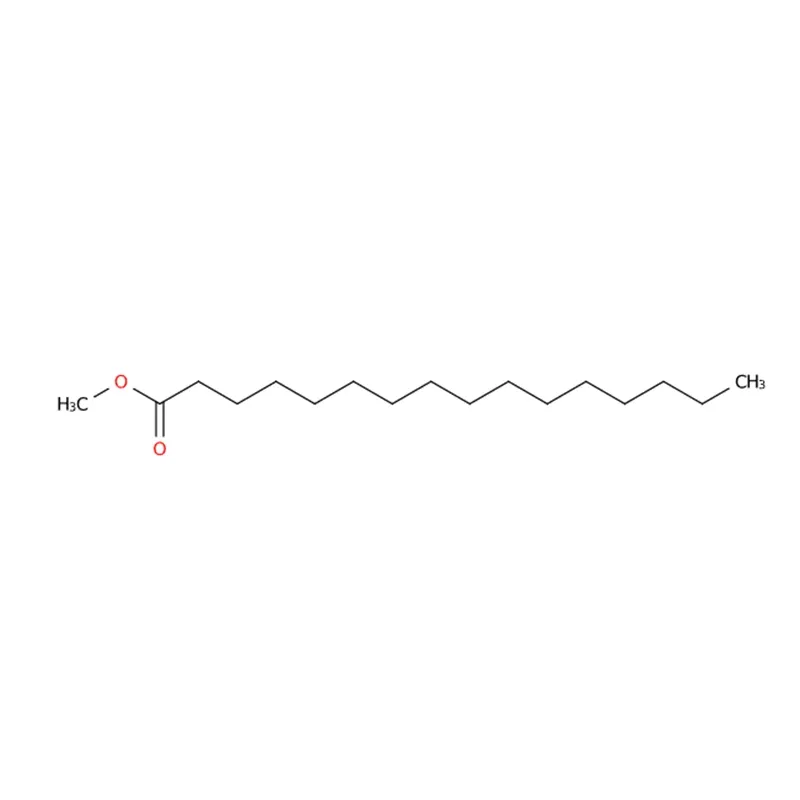
Product Details
Methyl palmitate is a fatty acid ester naturally present in the essential oils of various plant species.The cellular level of methyl palmitate may be affected by the existence of methanol.
Tests performed on isolated Kupffer cells have revealed that methyl palmitate is able to suppress phagocytosis and might lower cell survival rate.

Methyl palmitate Chemical Properties
| Melting point | 32-35 °C (lit.) |
| Boiling point | 185 °C/10 mmHg (lit.) |
| Density | 0.852 g/mL at 25 °C (lit.) |
| Vapor pressure | 0.008Pa at 25℃ |
| Refractive index | n20/D 1.4512(lit.) |
| Fp | >230 °F |
| Storage temp | 2-8°C |
| Solubility | Chloroform (Sparingly), Methanol (Slightly) |
| Form | Liquid or Low Melting Solid |
| Specific Gravity | 0.852 |
| Color | Clear colorless |
| Odor | at 100.00 %. oily waxy fatty orris |
| Odor Type | waxy |
| biological source | plant (palm) |
| Water Solubility | INSOLUBLE |
| BRN | 1780973 |
| LogP | 7.38 at 36℃ |
| CAS DataBase Reference | 112-39-0(CAS DataBase Reference) |
| NIST Chemistry Reference | Hexadecanoic acid, methyl ester(112-39-0) |
| EPA Substance Registry System | Methyl palmitate (112-39-0) |
| Statements | 22-24/25 |
| WGK Germany | 1 |
| TSCA | Yes |
| HS Code | 29157090 |
| Hazardous Substances Data | 112-39-0(Hazardous Substances Data) |
Product Usage
Methyl palmitate is extensively applied in the manufacture of detergents, emulsifiers, wetting agents, stabilizers, resins, lubricants, plasticizers, and animal feed additives.
It has also been documented to possess anti-inflammatory and anti-fibrotic characteristics.Research trials have demonstrated that methyl palmitate can alleviate bleomycin-induced lung inflammation and fibrosis in rats.Furthermore, it displays protective efficacy against carbon tetrachloride–induced liver fibrosis, which is linked to the downregulation of transforming growth factor beta (TGF-β), a protein that controls cell proliferation, differentiation, and diverse cellular activities.