

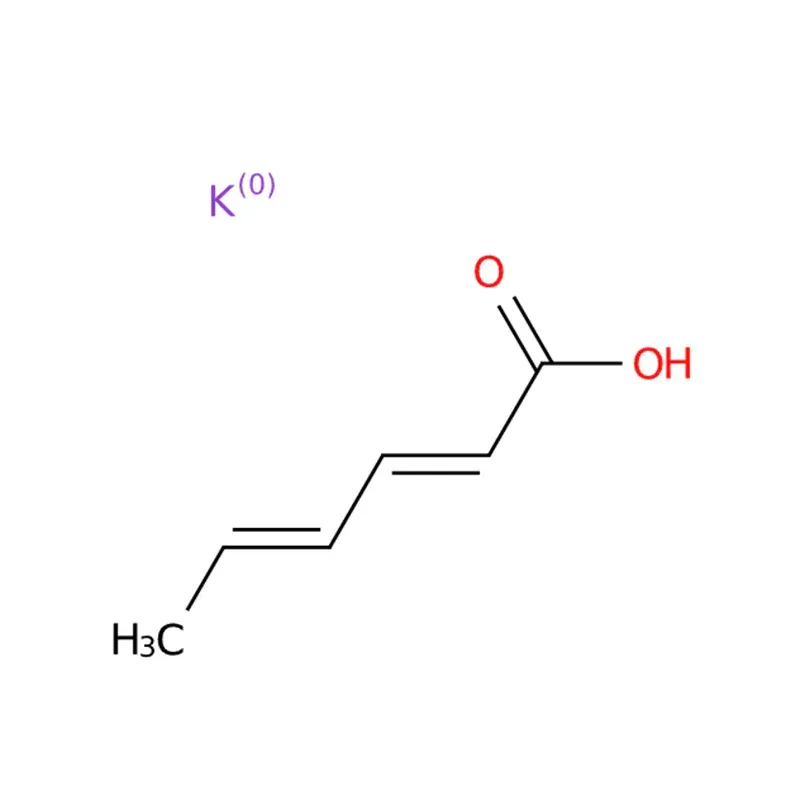
Potassium sorbate is the potassium salt of sorbic acid, appearing as a fine white crystalline powder. Initially discovered from mountain ash trees in the 1850s, it is currently mass-produced through standardized synthetic routes while retaining natural-mimicking molecular structure. The product features excellent biodegradability and high safety profiles. Once dissolved in water, it dissociates into active sorbic acid, which delivers strong inhibitory effects against molds, yeasts and partial harmful bacteria, making it a highly efficient and widely recognized food-grade preservative.

Potassium sorbate Chemical Properties
Melting point | 270 °C |
Density | 1,361 g/cm3 |
Vapor pressure | <1 Pa (20 °C) |
FEMA | 2921 | POTASSIUM SORBATE |
Storage temp | 2-8°C |
Solubility | H2O: 1 M at 20 °C, clear, colorless to faintly yellow |
Form | Powder |
Pka | 4.69[at 20 ℃] |
Color | White to light cream |
Odor | Odorless |
PH Range | 8 - 11 at 580 g/l at 20 °C |
PH | 7.8 (H2O, 20.1℃) |
Water Solubility | 58.2 g/100 mL (20 ºC) |
Merck | 14,7671 |
BRN | 5357554 |
Stability | Stable. Incompatible with strong oxidizing agents. |
InChIKey | CHHHXKFHOYLYRE-STWYSWDKSA-M |
LogP | -1.72 at 20℃ |
CAS DataBase Reference | 24634-61-5(CAS DataBase Reference) |
EPA Substance Registry System | Potassium sorbate (24634-61-5) |
Safety Information
Hazard Codes | Xi,C,T,F |
Risk Statements | 36/37/38-35-22 |
Safety Statements | 26-36-45-36/37/39 |
WGK Germany | 1 |
RTECS | WG2170000 |
Autoignition Temperature | >150 °C |
TSCA | Yes |
HS Code | 2916 19 95 |
Toxicity | LD50 orally in Rabbit: 3800 mg/kg |
Product Applications
Potassium sorbate is extensively applied in global food preservation, typically used at concentrations of 250 ppm to 1000 ppm. It is widely used in dairy products such as cheese, yogurt and sour cream; bakery products including bread, cakes, pies, fillings, baking mixes and icings; various beverages, margarine and salad dressings; fermented and pickled vegetables, olives and fruit products; smoked and salted fish, confectionery and mayonnaise. It effectively suppresses microbial growth, stabilizes product quality and extends the shelf life of diversified food commodities.