
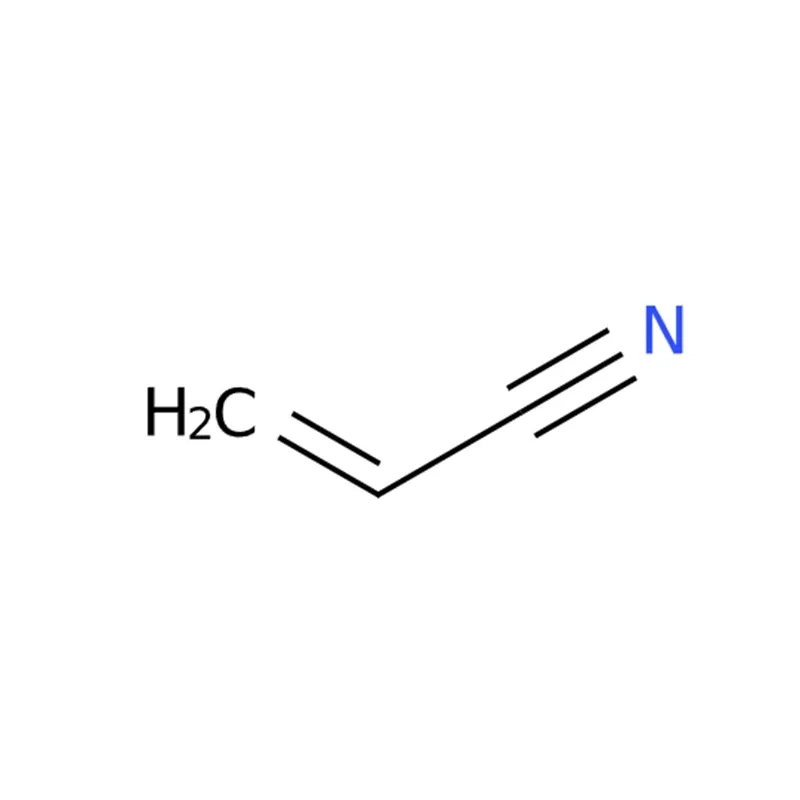
Product Description of Acrylonitrile CAS#107-13-1
Acrylonitrile is a colorless combustible liquid, and its vapor is capable of forming explosive blends once contacting open flames. This substance cannot be found in natural environments and is mass-produced by chemical manufacturers, witnessing steadily rising market demand in recent years.
Being a high-volume unsaturated nitrile product, acrylonitrile functions as a vital feedstock to manufacture a full range of chemical goods such as plastic materials, synthetic rubber and acrylic fiber. It once served as a fumigant for pesticides, yet all relevant pesticide application scenarios have been fully phased out at present.
As a critical synthetic chemical intermediate, acrylonitrile participates in organic synthesis to manufacture medicines, antioxidant agents, dyestuffs and multiple other chemical products. The core downstream buyers are producers of acrylic fiber, modacrylic fiber and high-toughness ABS resin.
Furthermore, acrylonitrile is adopted to synthesize styrene-acrylonitrile (SAN) resin, which is processed into auto parts, daily necessities and packaging supplies. It also covers production fields including office apparatus, travel luggage and construction raw materials. Its derivative adiponitrile can be further processed to make nylon, dyestuffs, pharmaceutical preparations and agrochemicals.
Acrylonitrile Chemical Properties
| Melting point | -83 °C (lit.) |
| Boiling point | 77 °C (lit.) |
| density | 0.806 g/mL at 20 °C |
| vapor density | 1.83 (vs air) |
| vapor pressure | 86 mm Hg ( 20 °C) |
| refractive index | n20/D 1.391(lit.) |
| Fp | 32 °F |
| storage temp. | 2-8°C |
| solubility | 73g/l |
| form | Liquid |
| color | Clear |
| PH | 6.0-7.5 (50g/l, H2O, 20℃) |
| Odor | Mild pyridine-like odor at 2 to 22 ppm |
| Odor Threshold | 8.8ppm |
| explosive limit | 2.8-28%(V) |
| Water Solubility | Soluble. 7.45 g/100 mL |
| Sensitive | Light Sensitive |
| Merck | 14131 |
| BRN | 605310 |
| Henry's Law Constant | 1.30 at 30.00 °C (headspace-GC, Hovorka et al., 2002) |
| Exposure limits | NIOSH REL: TWA 1 ppm, 15-min C 1 ppm, IDLH 85 ppm; OSHA PEL: TWA 2 ppm, 15-min C 10 ppm; ACGIH TLV: TWA 2 ppm. |
| Dielectric constant | 33.01 |
| LogP | 0.017 at 21℃ |
| CAS DataBase Reference | 107-13-1(CAS DataBase Reference) |
| IARC | 2B (Vol. 71) 1999 |
| NIST Chemistry Reference | 2-Propenenitrile(107-13-1) |
| EPA Substance Registry System | Acrylonitrile (107-13-1) |
| Hazard Codes | F,T,N,Xn |
| Risk Statements | 45-11-23/24/25-37/38-41-43-51/53-39/23/24/25-62-63 |
| Safety Statements | 53-9-16-45-61-36/37 |
| RIDADR | UN 1093 3/PG 1 |
| OEB | D |
| OEL | TWA: 1 ppm, Ceiling: 10 ppm [15-minute] [skin] |
| WGK Germany | 3 |
| RTECS | AT5250000 |
| F | 8 |
| Autoignition Temperature | 481 °C |
| TSCA | Yes |
| HazardClass | 3 |
| PackingGroup | I |
| HS Code | 29261000 |
| Hazardous Substances Data | 107-13-1(Hazardous Substances Data) |
| Toxicity | LD50 orally in rats: 0.093 g/kg (Smyth, Carpenter) |
| IDLA | 60 ppm |
Product Usage
Acrylonitrile is primarily used in the production of acrylic and modacrylic fibers. It also serves as an important raw material for manufacturing plastics, including acrylonitrile-butadiene-styrene (ABS) resins and styrene-acrylonitrile (SAN) resins, as well as adiponitrile, acrylamide, nitrile rubber, and barrier resins. Although a mixture of acrylonitrile and carbon tetrachloride was previously used as a pesticide, all pesticide applications have since been discontinued.
Acrylonitrile is a commercially significant industrial chemical that has been widely utilized since the 1940s, driven by the rapid development of the petrochemical industry.
The production of ABS and SAN resins represents the second-largest application area for acrylonitrile. ABS resins are manufactured by grafting acrylonitrile and styrene onto polybutadiene or styrene-butadiene copolymers, typically containing approximately 25 wt% acrylonitrile. These materials are widely used in automotive parts, recreational vehicle components, pipe fittings, and household appliances.
SAN resins are styrene-acrylonitrile copolymers containing approximately 25–30 wt% acrylonitrile. Due to their excellent transparency and clarity, SAN resins are commonly applied in automotive instrument panels, instrument lenses, and various household products.