

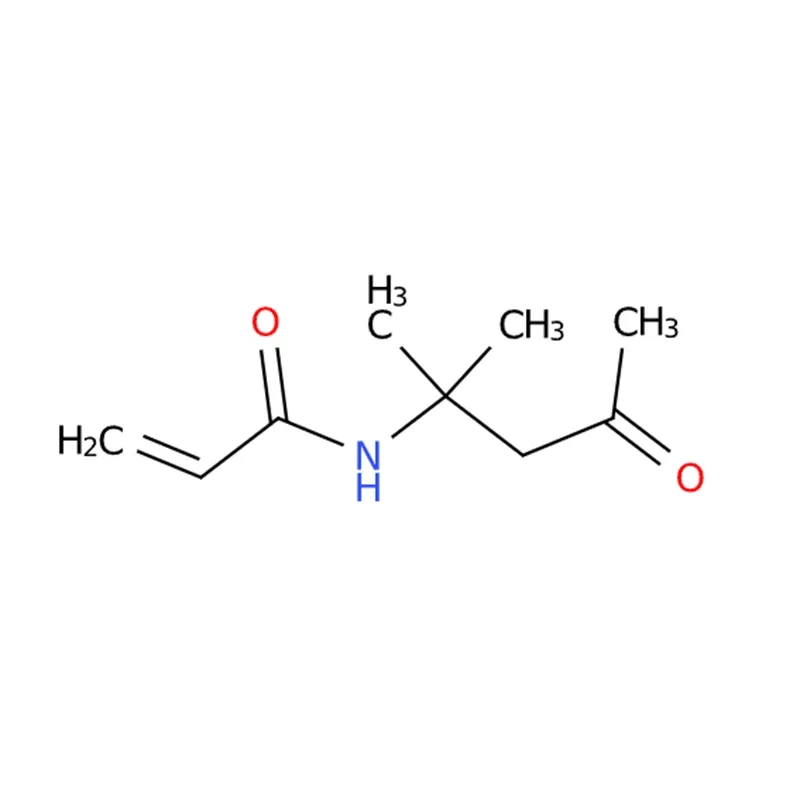
Product Description of Diacetoneacrylamide (CAS#2873-97-4)
Diacetoneacrylamide contains two highly reactive functional groups: an N-substituted amide group and a ketone group. It readily copolymerizes with ethylene and other vinyl monomers, enabling the effective integration of ketocarbonyl functionalities into polymer chains.
Through the reactivity of these ketocarbonyl groups, the polymers can undergo crosslinking and grafting reactions, making them suitable for the production of adhesives, thickeners, paper strengthening agents, crosslinkers, and other related products.
This product is widely applied in coatings, adhesives, daily chemical formulations, epoxy resin curing systems, photosensitive resin modifiers, textile additives, as well as medical and healthcare materials.
Diacetone Acrylamide Chemical Properties
| Melting point | 54-56 °C (lit.) |
| Boiling point | 120 °C (8 mmHg) |
| Density | 1.0873 (rough estimate) |
| Vapor pressure | 0.109Pa at 20℃ |
| Refractive index | 1.4200 (estimate) |
| Fp | >230 °F |
| Storage temp | Inert atmosphere,Room Temperature |
| Pka | 14.12±0.46(Predicted) |
| Form | Crystalline Powder or Flakes |
| Color | White to cream |
| Water Solubility | soluble |
| Sensitive | Hygroscopic |
| Merck | 142,963 |
| BRN | 1928444 |
| InChIKey | OMNKZBIFPJNNIO-UHFFFAOYSA-N |
| LogP | 0.321 at 21℃ |
| CAS DataBase Reference | 2873-97-4(CAS DataBase Reference) |
| NIST Chemistry Reference | 2-Propenamide, n-(1,1-dimethyl-3-oxobutyl)-(2873-97-4) |
| EPA Substance Registry System | N-(1,1-Dimethyl-3-oxobutyl)acrylamide (2873-97-4) |
Product Application of Diacetoneacrylamide (CAS#2873-97-4)
Diacetoneacrylamide is an important vinyl monomer. Its homopolymer is insoluble in water but possesses unique "water-breathing" properties, capable of absorbing water up to 20–25% of its own resin weight. When the ambient humidity drops below 60%, the absorbed moisture is gradually released, and during this process, water acts as a plasticizer for the polymer, endowing it with distinctive performance characteristics that support a wide range of practical applications.
(1) Hair Perm Resins with Excellent Moisture ResistanceIn Japan, it is widely used in moisture-resistant hair perm resins. Hairstyles treated with this material can maintain their shape for a long time and are not easily deformed by rain or washing, effectively enhancing the durability and stability of perm effects.
(2) Photosensitive ResinsAs a key raw material component in photosensitive resins, this product offers notable advantages:
Rapid photoresponse, ensuring efficient reaction during exposure
Easy removal of non-image areas after exposure, resulting in clear and sharp finished images
The formed patterns have excellent mechanical strength, solvent resistance, and water resistance, meeting the high requirements of various photoprocessing scenarios
In addition, it can also serve as a crosslinking agent for unsaturated polyester resins and diallyl phthalate resins, as well as a curing agent for epoxy resins. It is further applied in the production of "water-breathing" resins (such as contact lenses, anti-fog glass, and marine bottom coatings), pressure-sensitive adhesives, adhesive modifiers, nonwoven fabric binders, water-absorbing films, leather finishing agents and modifiers, paper strengthening agents, antistatic polymers, and inks, with broad application prospects in multiple industrial fields.
Safety Information
| Hazard Codes | Xn |
| Risk Statements | 22 |
| Safety Statements | 23-24/25 |
| WGK Germany | 1 |
| RTECS | AS3475000 |
| F | 3 |
| TSCA | Yes |
| HS Code | 29241990 |
| Hazardous Substances Data | 2873-97-4(Hazardous Substances Data) |
| Toxicity | LD50 orally in mice: 7.7 mmol/kg (Hashimoto) |


