

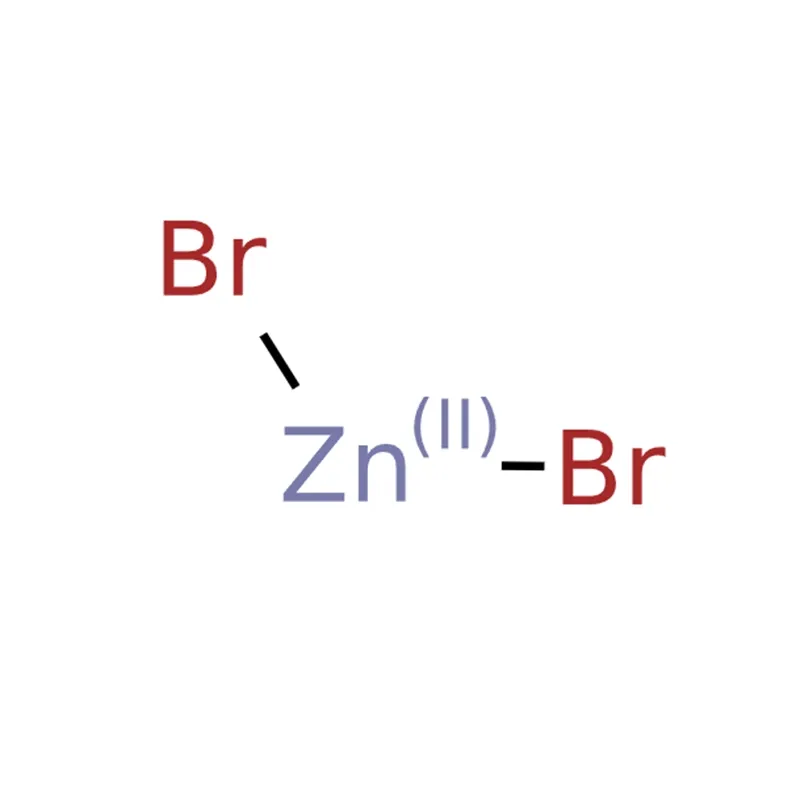
It appears as a white, deliquescent crystalline powder with a relative density of 4.5. Its melting point is 394℃, boiling point 650℃, heat of vaporization 118 kJ/mol, heat of fusion 16.70 kJ/mol, and refractive index 1.5452 (20℃). It is easily soluble in water, alcohol, ether and acetone, and soluble in alkali metal hydroxide solutions.

Zinc Bromide Chemical Properties
| Melting point | 394 °C (lit.) |
| Boiling point | ~670 °C/1 atm (lit.) |
| Density | 4.22 |
| Refractive index | 1.5452 |
| Fp | 650°C |
| Storage temp. | Store below +30°C. |
| Solubility | Soluble in alcohol, ether, acetone and tetrahydrofuran. |
| Form | beads |
| Color | White to pale cream |
| Specific Gravity | 4.2012 |
| PH | 4 (H2O, 20℃)(saturated solution) |
| Water Solubility | soluble, 447 g/100 mL (20 ºC) |
| Sensitive | Hygroscopic |
| Merck | 141,029 |
| Stability | Stable. Forms explosive mixtures with sodium and potassium. Protect from moisture. |
| CAS DataBase Reference | 7699-45-8(CAS DataBase Reference) |
| NIST Chemistry Reference | Zinc dibromide(7699-45-8) |
| EPA Substance Registry System | Zinc bromide (77699-45-8) |
It serves as a chemical analysis reagent and raw material for photographic emulsions, widely applied in the pharmaceutical industry. It acts as a post-treatment agent for synthetic fibers, and functions as high-quality completion fluid & cementing fluid for offshore oilfields as well as battery electrolyte. In pharmaceutical and photographic fields, it supports the protection of nuclear reaction windows, and can be used to prepare silver bromide colloidal emulsions for photographic applications.

Safety Information
| Hazard Codes | C,N |
| Risk Statements | 34-50/53-50-51/53-43-22 |
| Safety Statements | 26-36/37/39-45-60-61-29 |
| RIDADR | UN 3260 8/PG 3 |
| WGK Germany | 3 |
| RTECS | ZH1150000 |
| F | 3-21 |
| TSCA | Yes |
| HS Code | 2827 59 00 |
| HazardClass | 8 |
| PackingGroup | II |
| Hazardous Substances Data | 7699-45-8(Hazardous Substances Data) |


