
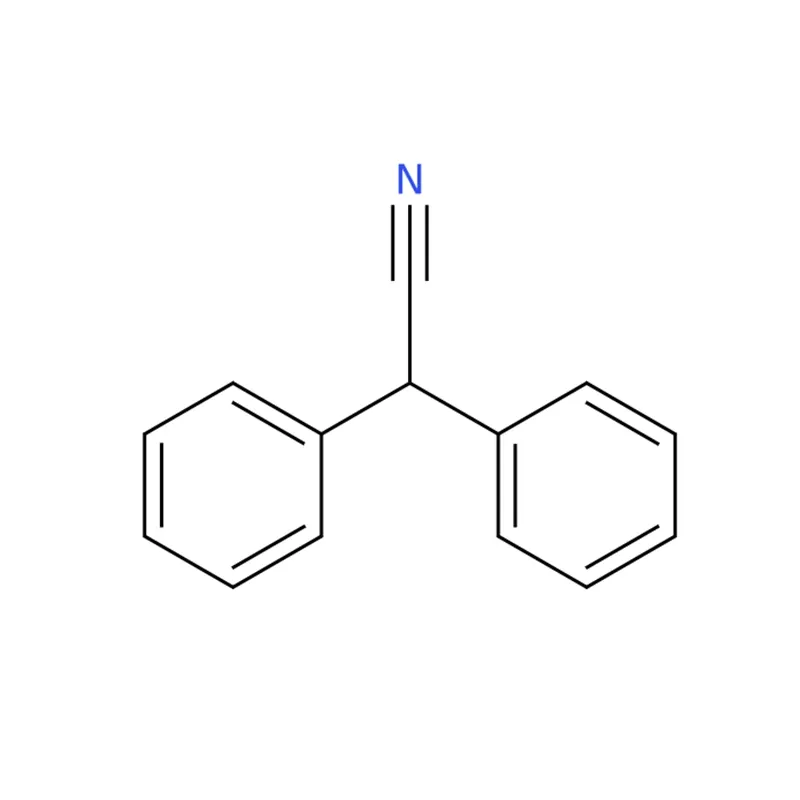
Diphenylacetonitrile Chemical Properties
| Melting point | 71-73 °C (lit.) |
| Boiling point | 181 °C/12 mmHg (lit.) |
| Density | 1.1061 (rough estimate) |
| Vapor pressure | 21.3 hPa (190 °C) |
| Refractive index | 1.5850 (estimate) |
| Fp | 120 °C |
| Storage temp | Store below +30°C. |
| Solubility | INSOLUBLE |
| Form | Crystalline Powder |
| Color | White to creamy or faint yellow |
| Water Solubility | INSOLUBLE |
| Merck | 143316 |
| BRN | 1911160 |
| Exposure limits | NIOSH: IDLH 25 mg/m3 |
| InChIKey | NEBPTMCRLHKPOB-UHFFFAOYSA-N |
| LogP | 2.795-3.197 at 25℃ |
| CAS DataBase Reference | 86-29-3(CAS DataBase Reference) |
| NIST Chemistry Reference | Benzeneacetonitrile, «alpha»-phenyl-(86-29-3) |
| EPA Substance Registry System | Diphenylacetonitrile (86-29-3) |
| Hazard Codes | Xi |
| Risk Statements | 36/37/38 |
| Safety Statements | 26-36-37/39 |
| WGK Germany | 2 |
| RTECS | AL9800000 |
| TSCA | Yes |
| HS Code | 29269095 |
| Toxicity | LD50 orally in Rabbit: 3500 mg/kg |
Product Application of Diphenylacetonitrile CAS#86-29-3
Diphenylacetonitrile is employed in the synthesis of isocyanates, which can be further processed into UV coatings, polyurethane (PU) coatings, transparent elastomers, and adhesives. It also finds application in the polyamide and epoxy resin industries.
Moreover, it acts as an important intermediate in organic synthesis. In the pharmaceutical sector, it is used in the preparation of gastric amines, phenylephrine, analgesics, and other pharmaceutical compounds.