

Product Details
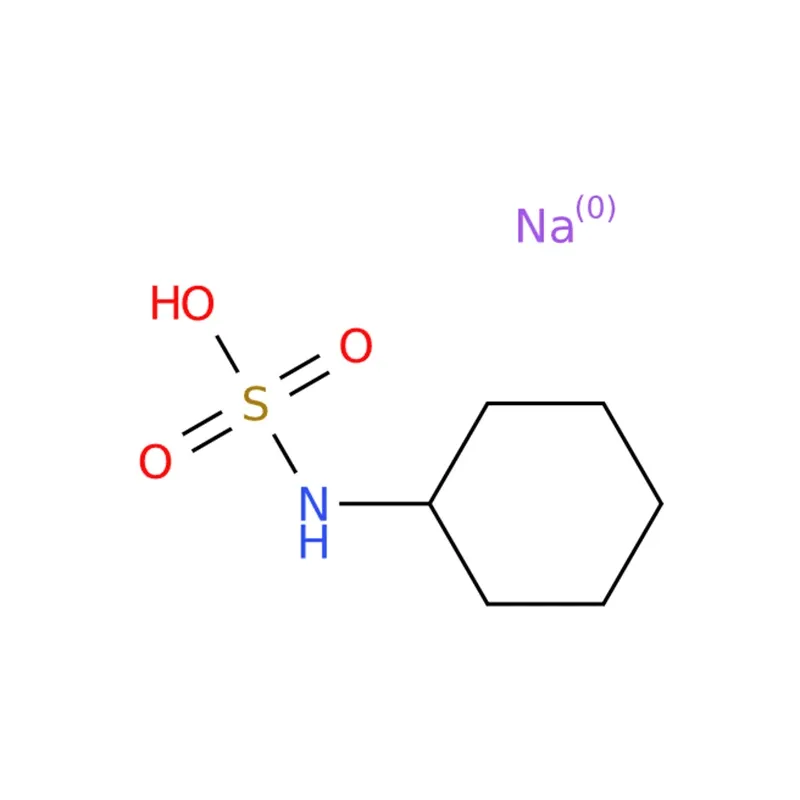
Sodium cyclamate appears as an odorless white crystalline powder, with a sweetness intensity 40–50 times higher than sucrose. It is freely soluble in water (1g/5mL), slightly soluble in propylene glycol (1g/25mL), and practically insoluble in ethanol, chloroform, benzene and ether. A 10% aqueous solution exhibits a neutral pH of 6.5. Non-hygroscopic in nature, this product possesses excellent resistance to alkali, light and thermal exposure, with a decomposition temperature of 280°C.
English name | Sodium N-cyclohexylsulfamate |
English synonyms | assurgrinfeinsuss;assurgrinvollsuss;asugryn;cyclamate,sodiumsalt;cyclamic;cyclohexanesulfamicacid,monos odiumsalt;cyclohexanesulphamicacid,monosodiumsalt;cyclohexyl-sulfamicacimonosodiumsalt |
CAS number | 139-05-9 |
Molecular formula | C6H14NNaO3S |
Molecular weight | 203.23 |
EINECS number | 205-348-9 |
Melting Point | >300°C (lit.) |
Density | 1.58 [at 20°C] |
Vapor Pressure | 0.002 Pa at 150°C |
Storage Conditions | Room temperature |
Solubility | 200 g/L |
Form | Powder |
Color | White |
PH | 5.5-7.5 (100 g/L, H2O, 20°C) |
Odor | Odorless. Sweet taste, detectable at concentrations above 100 ppm in water. |
Water Solubility | >=10 g/100 mL at 20°C |
Merck | 142703 |
BRN | 4166868 |
Stability | Hygroscopicity |
InChIKey | UDIPTWFVPPPURJ-UHFFFAOYSA-M |
LogP | -2.63 at 20°C |
Sodium cyclamate is a versatile non-nutritive artificial sweetener with zero calorie content and non-cariogenic characteristics. It cannot be absorbed by the human body and delivers a flavor highly similar to sucrose. Commonly blended with sodium saccharin, it effectively covers the bitter aftertaste of saccharin to improve overall taste quality. Widely applicable in food processing, it is ideal for preserved fruits such as dried tangerine peel, preserved plums and dried bayberries, as well as pickles, condiment sauces, alcoholic drinks, popsicles, ice cream, cakes, biscuits and bread products.