
Product Details
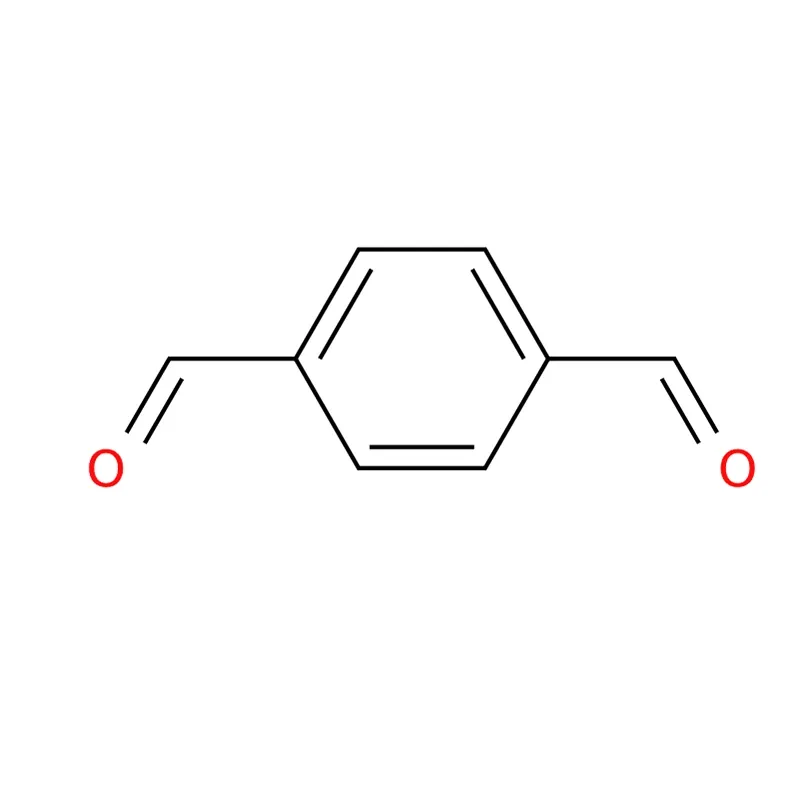
Product Description of Terephthalaldehyde CAS#623-27-8
Terephthalaldehyde is a vital fine chemical intermediate obtained from paraxylene. Its molecular framework includes two reactive aldehyde groups, allowing it to carry out homopolymerization or copolymerization with other monomers to form diverse polymer materials. These polymers are broadly utilized in the preparation of fluorescent materials, catalyst supports, and other high-performance polymer products.
Conventionally, terephthalaldehyde is synthesized via chlorination of p-xylene and subsequent hydrolysis catalyzed by nitric acid or metal oxides.
Terephthalaldehyde Chemical Properties
| Melting point | 114-116 °C (lit.) |
| Boiling point | 245-248 °C (lit.) |
| Density | 1,06 g/cm3 |
| Vapor pressure | 0.25-0.46Pa at 20-25℃ |
| Refractive index | 1.4800 (estimate) |
| Fp | 76 °C |
| Storage temp | Store below +30°C. |
| Solubility | 3g/l |
| Form | Crystalline Powder |
| Color | White to light yellow |
| Water Solubility | 3 g/L (50 ºC) |
| Sensitive | Air Sensitive |
| BRN | 385863 |
| InChIKey | KUCOHFSKRZZVRO-UHFFFAOYSA-N |
| LogP | 1 at 20.1℃ and pH6.6-6.8 |
| CAS DataBase Reference | 623-27-8(CAS DataBase Reference) |
| NIST Chemistry Reference | 1,4-Benzenedicarboxaldehyde(623-27-8) |
| EPA Substance Registry System | 1,4-Benzenedicarboxaldehyde (623-27-8) |
| Hazard Codes | Xi |
| Risk Statements | 36/37/38-36/37 |
| Safety Statements | 22-24/25-36-26-37/39 |
| WGK Germany | 1 |
| RTECS | WZ0430000 |
| Hazard Note | Irritant |
| TSCA | Yes |
| HS Code | 29122900 |
| Hazardous Substances Data | 623-27-8(Hazardous Substances Data) |
Product Application of Terephthalaldehyde CAS#623-27-8
Terephthalaldehyde is mainly employed in the manufacture of brighteners, resins, plastics, and pesticides. It also participates in the synthesis of diverse organic compounds, including intermediates like bromocyclopentane. Furthermore, it can be used in the preparation of solid iodophor disinfectants, in which surfactants serve as carriers to form complexes with iodine. Such disinfectants feature broad-spectrum efficacy, high efficiency, excellent bactericidal activity, favorable stability and safety, and are applicable to scenarios including preoperative skin disinfection as well as sanitization of oral, intestinal, urethral and cervical mucous membranes.